



Alone in The Dark
I was by myself in Brazil. My friend had flown to Peru to meet up with his family, my other friend had flown home and I wasn’t supposed to meet up with someone else for a few weeks. I was a little nervous to be honest; I had heard many horror stories.
“Did you know that Salvador da Bahia is the most dangerous city in the world?” some people asked me. “You should NEVER take your camera out with you. If you take your camera with you, you will surely get mugged, or killed!”
“Make sure you try not to act like a tourist. They will rob you for sure.”
“You should never walk around at night, even WITH someone else”.
“You shouldn’t stay in the Pelourinho (the old town). It’s very dangerous.”
I had heard it all before....
You can read the REST of THIS STORY and find out if I survived, on Women Rockin' The Road, a new collaborative travel blog! Please join me over there today!
Also, (you can find more information in this post) you too can contribute your travel stories! Go HERE to find out more.

Bonito Mato Grosso do Sul

Bonito, one of the principal gateways to the region of Pantanal, is itself a city with huge biodiversity and one of the top eco-tourism destinations in Brazil. Just as the name says (Bonito=beautiful) the mother nature has created an amazing number of wonders in this region. The caverns and rivers with transparent blue waters form unique diving and snorkeling spots allowing you to admire this vibrant subacuatic world formed by fresh water springs.
Beside of snorkeling the diverse eco-tourism attractions of Bonito take you to the waterfalls and rivers. Adventure hikes reveal the richness of flora and fauna in this region. Thanks to the well-organized tourism sector, Bonito has conserved the beauty of its' attractions and avoided the negative impact of tourism by limiting a number of tourists visiting the sights. It's also worth remembering that the access to all eco-tourism sights in Bonito is allowed only with a qualifield accompanying guide.
LOCATION:
Bonito located in the southwestern corner of Mato Grosso do Sul state. The closest airport receiving national flights is located in Campo Grande, the capital of the state, approximately 280 km of distance from Bonito. The easiest and the quickest access to reach Bonito is by taking a private transfer, which takes you from Campo Grande to Bonito in about 3 hours.
BEST TIME TO VISIT:
Bonito can be visited at any time of the year, though often the rainy season in between December and March is said to be the best one, due to the green vegetation and animals coming out of their hides in search of alimentation.
WHAT TO DO:
Participate on excursions taking you to the shores of Formosa river, where many activities including snorkeling in crystal clear waters can be practised. Out of the shoreside destinations Balneário do Sol, Balneário Municipal and Praia da Figueira tend to be the most popular places to be explored. Visit also the cave of Gruta do Lago Azul, hike through the wild vegetation, practise horseback riding or feel emotions while rappeling in the middle of this beautiful nature.

Tourism attractions in Bonito
Bonito is one of the main ecological destinations in Brazil. Bonito has a rare combination of crystaline rivers and lagoons, caves and forests. There is a huge variety of colorful fishes, which can be observed very closely.

Places to visit:
Gruta do Lago Azul (Grotto of Blue Lagoon). This is a calcareous cave, with stalactites and stalagmites. The cave was found in 1924, and since 1978 it was declared National Heritage.
Inside the cave, 340 meters from the entrance, there is the Blue Lagoon; the Blue Lagoon is 70 m deep and 120 m wide, with waters incredibly blue.
Best epoch to visit the Groot is from November to January, from 8h30 am to 9h00 am; during this short time frame, the sun rays reach the entrance of the cave, illuminating the interior.
Notice: access is forbidden for children under 5 y.o. There is an entrance fee of R$ 25 (2005).

Floating. The rivers of Bonito have a high concentration of calcareous; this has two effects useful for nature admirers: it facilitates the boyance and gives the water a high transparency (up to 30 meters, in some points).
The practice of floating consists in, wearing mask, snorkel and neoprene suit, to float on the surface of the water while being carried by the stream. The vision is of rare beauty: colorful fishes (piraputangas, dourados, pintados, piaus) and the rich underwater flora.
Shops and tour operators rent water proof cameras.
Best period for practice of floating is between June and September, the dry season, when the waters become more crystaline.

Diving. Bonito is the main destination in Brazil for diving in rivers and lagoons (for diving in sea water, Fernando de Noronha is more popular). There are specific points for people with different levels of experience (basic, advanced, certified).
The flooded caves, like Abismo Anhumas and Gruta do Mimoso, are exclusive for the more experienced divers. For beginers, there are introdutory courses on the rivers da Prata and Formoso.
In any case, the diving trips must be intermediated by tour operators; equipment is available for rent.
There are several other activies in Bonito, all related to eco tourism. The parks around the city have trails for trekking, usually ending in a waterfall or other landscape to be admired. Many caves and lagoons are also visited by trekkers.
There are shops offering products crafted by the indians of the tribe kadiwéu, who live in the region.

Places to visit:
Gruta do Lago Azul (Grotto of Blue Lagoon). This is a calcareous cave, with stalactites and stalagmites. The cave was found in 1924, and since 1978 it was declared National Heritage.
Inside the cave, 340 meters from the entrance, there is the Blue Lagoon; the Blue Lagoon is 70 m deep and 120 m wide, with waters incredibly blue.
Best epoch to visit the Groot is from November to January, from 8h30 am to 9h00 am; during this short time frame, the sun rays reach the entrance of the cave, illuminating the interior.
Notice: access is forbidden for children under 5 y.o. There is an entrance fee of R$ 25 (2005).

Floating. The rivers of Bonito have a high concentration of calcareous; this has two effects useful for nature admirers: it facilitates the boyance and gives the water a high transparency (up to 30 meters, in some points).
The practice of floating consists in, wearing mask, snorkel and neoprene suit, to float on the surface of the water while being carried by the stream. The vision is of rare beauty: colorful fishes (piraputangas, dourados, pintados, piaus) and the rich underwater flora.
Shops and tour operators rent water proof cameras.
Best period for practice of floating is between June and September, the dry season, when the waters become more crystaline.

Diving. Bonito is the main destination in Brazil for diving in rivers and lagoons (for diving in sea water, Fernando de Noronha is more popular). There are specific points for people with different levels of experience (basic, advanced, certified).
The flooded caves, like Abismo Anhumas and Gruta do Mimoso, are exclusive for the more experienced divers. For beginers, there are introdutory courses on the rivers da Prata and Formoso.
In any case, the diving trips must be intermediated by tour operators; equipment is available for rent.
There are several other activies in Bonito, all related to eco tourism. The parks around the city have trails for trekking, usually ending in a waterfall or other landscape to be admired. Many caves and lagoons are also visited by trekkers.
There are shops offering products crafted by the indians of the tribe kadiwéu, who live in the region.

Bonito, Mato Grosso do Sul
Bonito is a municipality located in the Brazilian state of Mato Grosso da Sul. Its population was 17,275 (2007) and its area is 4,934 km².[1].Bonito is in the middle of a region which is being discovered as "Caribe do Centro-Oeste" (Caribbean of the Central-West) due to the unbelievable blue colour of its waters.
Owing to the enormous quantity of limestone in the ground, the water of these rivers passes through a real natural filter where impurities are deposited at the bottom of the river bed, leaving the rivers to be some of the clearest and most transparent in the world. A number of fish and plant species have adapted to this high calcium environment, so that all rivers teem with life. The government of the region has consciously aimed to promote tourism and develop infrastructure for receiving and directing tourists, while strictly controlling the numbers of tourists allowed. These limitations are aimed at preserving the rich natural beauty of the area, maintaining popular tourist sites as close as possible to their natural state.
There are more than 30 tours available in and around the Bonito area. The majority of the tours are based around exploring the ecology and natural environment of the area. Almost all of the tours need to be booked through an official tourist agency in the town and require an accredited guide, although this will be organised at the time of booking. Some of these most popular tours include:
- Abismo Anhumas (Anhumas Abism) -
- Rio da Prata (Silver River) - This award-winning snorkelling tour features crystal-clear water, lots of fish,a walk through the forest and a delicious lunch.
- Aquário Natural (Natural Aquarium) - The tour starts with a 25 minute walk through the jungle, followed by a 900 m snorkel, where you float with fish and appreciate the underwater vegetation. After starting the trek where you can see varieties of animals of the region, you can finish with a visit to the museum of natural history.
- Circuito Arvorismo (The trees circuit) - The adventure trek allows you to walk through the treetops on a suspended steel walkway installed in native trees such as Aroeira and Mahogany. The walkways have platforms fixed in the trees, varying in height from 10 to 20m.
- Gruta do Lago Azul (Blue Lake Cave) - The tour starts with a 10 minute walk to the entrance of the cave, which was discovered by a local Indian in 1924. In its interior, after descending 100 meters, it is possible to see the lake of crystal clear water and depth of approximately 90 meters, which makes it one of world’s biggest flooded caves.

Bonito, Mato Grosso do Sul

The river water around the town of Bonito is startlingly clear. Depending on the light, the waters here can appear bright turquoise, and its clarity makes it easy to see the fish that make rivers such as the Sucuri River, their home. You might encounter diverse species such as the large round piraputanga and the tiny gleaming silver fish, aptly named 'shiners'.
The water is crystal clear because it filters naturally though the region's limestone rock. With snorkels and floatation devices you can drift along with the current enjoying the view of the vegetation and wildlife as you go, as the dappled sunlight brightens the river floor. There are a number of Brazil tours that enable you to enjoy Brazilian scenery in this way; most are comprised of a combination of overland trekking and underwater exploration.
Preserving the beauty of the area around Bonito is a priority for local people, so operators offering Brazil tours have to be registered and the number of visitors to the region is regulated. This means those who visit on holidays to Brazil are a privileged few.

Boca da Onca Waterfall

The Boca da Onca Waterfall is one of several falls near Bonito. You can find it in an area of forest that is lush and green. People enjoying their Brazil tours here will be invited to take a dip in the picturesque plunge pool at the base of the falls, where you can feel the rhythm of the water falling around you.
The water drops from a height of about a hundred metres, cascading in several sections, rounding and smoothing the rocks into curved shapes. There are steps in the pools and caves in the walls of the gorge that you can swim through.
Once again, ecological concerns mean that visitors on holidays to Brazil are asked to take a shower before they enter the pools because some chemicals in sun cream can be poisonous to fish and local wildlife. If you're lucky, you might see vultures, toucans, armadillos or anteaters in the area surrounding the falls.

The Blue Lake Cave (Gruta do Lago Azul)

A hundred metres underground you can see the Blue Lake Cave, which is filled with water to a depth of a further ninety metres. When undisturbed, the surface of the lake provides a magical mirror image of the rock formations above. Stalactites and stalagmites bedeck the sides and ceiling of the cave in straw-like, feathery or bulbous shapes left by deposits over thousands of years. There are great opportunities to take some stunning Brazil holiday photos here.
The best time to visit the cave is in the morning. At this time of day, the sunlight will shine through a hole in the grotto's ceiling to show the true colours of the water, with hues of sapphire or topaz. Scuba divers on archaeological expeditions have discovered the bones of prehistoric animals in the cave. Although home to animals for aeons, the cave was not discovered by man until 1924, and now its beauty can be enjoyed by visitors on holidays to Brazil.

Bird Watching Prospects in the Amazon Rainforest

Once you catch bird watching fever, the completion of your life list will become a dream. In that dream, there is little doubt that you will see the famous Amazon Rainforest.
Bird Watching Prospects in the Amazon Rainforest
Encompassing about 1,500 species in the land where the world's second longest river flows, the Amazon Rainforest is a unique birding habitat . This region of South America from the Peruvian Andes to the South Atlantic in Brazil is known as Amazonia.
The Amazon River and shoreline is a major destination for bird watchers with 4,000 miles of shoreline. It is estimated that about 15 percent of all known bird species in the world have their habitat here, which represents only 4 percent of the planet's land surface.

The Amazon Rainforest is a 7 million km square (1.2 billion acres) moist broad leaf forest from 9 nations, Bolivia, Peru, Ecuador, Colombia, Venezuela, Guyana, Suriname, French Guiana and Brazil, the country which encompasses 60 percent of the Amazon rainforest. The range of nations and the characteristics of the forest contribute to making this region home of the world's tiniest hummingbirds. The area includes such rare species as the hoatzin, toucan, and the umbrella bird.
Amazonia forest also represents over half of the planet's remaining rainforests, one of the few areas where bird watchers can find such life list necessities as exotic parrots, umbrella birds and trogons. The high diversity of Amazon species includes resident species, wintering in, migrating birds, or just passing though the region.

Few of the species are found throughout the vast rainforest. Instead, each has particular habitats in particular areas. Species at the base of the Andes are far different than those found closer to the vast Amazon River basin. In short, one has to have a thorough knowledge of specific species before simply heading down to South America on a birding expedition.
The Amazon Rainforest represents one of the last great ecological environments on our planet. Alas, humanity is encroaching on it every day, slashing and burning acre after acre. While it is nice to imagine this destruction will soon stop, it is best to pursue any birding trip in the next ten years or so. After all, the planet is changing and they think there may be trees growing on Antarctica in the next hundred years or so!

Pantanal
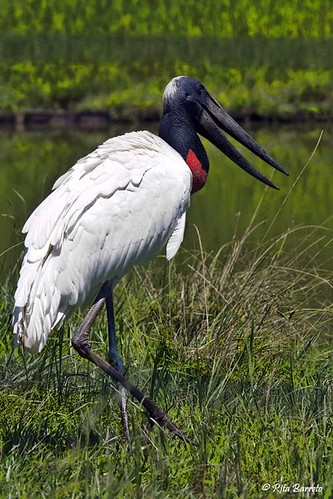 |
| Tuiui (source) |
We were hoping to see an anaconda and a giant anteater and a jaguar...or an anaconda eating an anteater and both of them being eaten by a jaguar... but it was not meant to be. We did see an anteater named Phillipe when we got to the border town of Corumba. It was really cool. He was really big and has no teeth but will suck on your fingers and lick you with his weird tongue. He does have large claws, but is basically like a big funny looking dog. (pics will be put online later)
Now we are in Bolivia. We just arrived today after a long (23 hours)  ride on the Death Train, which goes from Quijarros (the border) to Santa Cruz. The ride was good, although long, and we did not have any scary situations. The reason it is called the Death Train is because apparently in the 80s they used to carry a lot of contraband in the inside of the train and the people would ride on the top. The train used to derail a lot and many of the people on the top got killed. Hence the name. But now it does not derail as much and I did not see anyone riding on the top (or any contraband *wink, wink*)
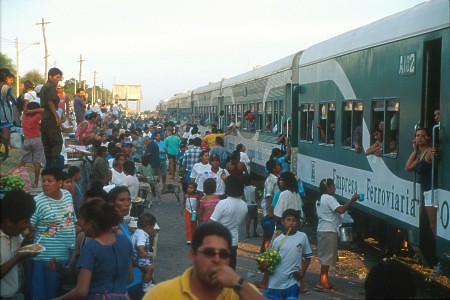 ride on the Death Train, which goes from Quijarros (the border) to Santa Cruz. The ride was good, although long, and we did not have any scary situations. The reason it is called the Death Train is because apparently in the 80s they used to carry a lot of contraband in the inside of the train and the people would ride on the top. The train used to derail a lot and many of the people on the top got killed. Hence the name. But now it does not derail as much and I did not see anyone riding on the top (or any contraband *wink, wink*)
Next stop, the Jesuit Mission Circuit, which is a few hours East of the town of Santa Cruz, where we are now. We are excited to be in Bolivia, but it is going to be hard to adjust to the temperature after being in the warmth of Brazil for so long! Where we are going in the next couple weeks, it gets way below freezing! Oh and now that I finally learned a few words in Portuguese, I have to switch my brain back to Spanish! Oh mio dios...

Jericoacoara - Land of Sand
 I found my new favorite place! It was hard to get to, but in the end, it was totally worth it! To get here, I had to take a bus for 2 hours, wait for another 2 hours, take another bus for 8 hours, wait for another 2 hours, take a bus for 5 hours, get off and then on to another "bus" (this one is 4 wheel drive, open sided with bench seats and the luggage goes on the top) for an additional hour.
After all that, I arrive in a town with all sand roads, no sidewalks, barely 2 small markets and no stress. This town is, as the locals say, TRANQUILO, tranquil, layed back and beautiful. The beach stretches some 30 km the town one way and I dont know how many the other way... I was going to stay here for two or three days and then...Chris finally met back up with me AND we both loved it so much we ended up staying about a week. We met some great people, hung out at the beach, relaxed at the hostel with our books, chatted with the owners of the pousada, hiked up sand dunes, rode horses, watched MANY sunsets.... it was great.
 Then we decided to get back to the real world...but first we wanted to go to a Park called Lençois Marahenses, which is full of sand dunes and lakes. But to get there, we had to...take a 4x4 for about 2 hours, a van for about 3 hours, a bus for about 4 hours...to the town of Tutoia, where we spent the night. Then the next day, we took another 4x4 to a small town where we spent the night, then the next day another two hours to Barrerinhas, where you can do a jeep tour to the dunes. Whew!
The jeep tour was great! We went in the afternoon to be able to see the sunset, but it was kind of cloudy. However, we did swim in a few warm fresh water lakes and hike over some beautiful white dunes...
 Next we went to the big city of Sao Luis, where we walked around the colonial center, met a bunch of people and got to see the locals practicing for the Bumba do Moi festival by dancing around in cool feather costumes...It was very cool!
So, next stop, Brasilia and then the Pantanal!
In The Jungle, The Mighty Jungle...
I have arrived in the Amazon and there are many trees.
We first arrived in Manaus, which is not the middle of the jungle villiage you imagine. It is a teeming city of over two million people, which is a major hub for commerce on the river. It reminds me of something that used to be a beautiful place and could still be if it hadnt gone into disrepair years ago and never recovered. The city is filled with what used to be beautiful buildings, with tile façades and gated courtyards, but are now covered with soot and dirt and grime.
Next a boat cruise was in order. There are two ways you can do it... 1) like the locals, who use the Amazonas River as a means of transport as well as commerce. This entails a 3-5 day trip from Belem to Maunaus, which can be fun. However, the river is quite wide and you dont really get to see a lot of wild life. 2) a group tour, with a bunch of white people. We chose the latter. Which I was not really too keen on at first, becuase going with a bunch of other tourists is not usually my thing. However, it was GREAT! The first day we went on a sunset canoe ride and saw snakes, birds and frogs. The next day we went on a sunrise canoe and saw another snake and many birds, including parrots and macaws. We also took a hike and learned a lot about the flora of the jungle. There are about 800 species of vines, many of them with medicinal properties. There are more than 3000 species of trees in the Amazon. And 3000 fish, 70% which are edible. And the Amazon dumps more water in one day into the ocean than the Thames river dumps in ONE YEAR!!! Crazy huh?
The next day we went piranha fishing. I caught NO piranha, but our driver caught about 7. I kept feeling them nibble, but could never jerk the line up fast enough to catch one. They are smaller than you think and most of them do not eat human. So, there goes that myth.
The last day we went to see the meeting of the waters, where the Rio Negro meets the Amazonas river. The Rio Negro is black and the Amazonas is brown and they flow next to each other for about 3-5 miles without mixing. It is pretty cool!
So, I got a little bit of edumacation and had a very awesome time on my jungle trip!
We first arrived in Manaus, which is not the middle of the jungle villiage you imagine. It is a teeming city of over two million people, which is a major hub for commerce on the river. It reminds me of something that used to be a beautiful place and could still be if it hadnt gone into disrepair years ago and never recovered. The city is filled with what used to be beautiful buildings, with tile façades and gated courtyards, but are now covered with soot and dirt and grime.
Next a boat cruise was in order. There are two ways you can do it... 1) like the locals, who use the Amazonas River as a means of transport as well as commerce. This entails a 3-5 day trip from Belem to Maunaus, which can be fun. However, the river is quite wide and you dont really get to see a lot of wild life. 2) a group tour, with a bunch of white people. We chose the latter. Which I was not really too keen on at first, becuase going with a bunch of other tourists is not usually my thing. However, it was GREAT! The first day we went on a sunset canoe ride and saw snakes, birds and frogs. The next day we went on a sunrise canoe and saw another snake and many birds, including parrots and macaws. We also took a hike and learned a lot about the flora of the jungle. There are about 800 species of vines, many of them with medicinal properties. There are more than 3000 species of trees in the Amazon. And 3000 fish, 70% which are edible. And the Amazon dumps more water in one day into the ocean than the Thames river dumps in ONE YEAR!!! Crazy huh?
The next day we went piranha fishing. I caught NO piranha, but our driver caught about 7. I kept feeling them nibble, but could never jerk the line up fast enough to catch one. They are smaller than you think and most of them do not eat human. So, there goes that myth.
The last day we went to see the meeting of the waters, where the Rio Negro meets the Amazonas river. The Rio Negro is black and the Amazonas is brown and they flow next to each other for about 3-5 miles without mixing. It is pretty cool!
So, I got a little bit of edumacation and had a very awesome time on my jungle trip!


Chopping Broccoli
You never realize that when you travel you are going to miss some things. Little things. ¨Normal¨ things. Everyone alwasys wonders how much fun you are having, what new things you are doing, who you are meeting, etc. But sometimes I just want people to tell ME what THEY did today, who they hung out with and what they did. The normal things, the mundane, everyday, normal things have become more desirable to me. I want to go to dinner on Friday night with the normal work crowd. I want to have a beer at Vics while watching the koala fly back and forth. I want to play pool at Cooter Browns; I want to make pizza with Matt and Pam; I want to hike to Bucks creek with Dad and Shay. Okay, so I am not saying I am not having fun, quite the contrary, but it is funny how we always miss or want what we dont have.The food here is good. A lot of it is fried, but there is also a lot of good local food, seafood and fruit...oh the fruit! It is delicious. Many papaya (mamãou), pineapple (abacaxi), passion fruit, watermelon and more! Every day for breakfast I eat about one ton of fruit. However, I had a dream the other day about broccoli, and now I want some broccoli SO bad! However, they dont have it here at all. Well, at least I have not seen it. And it is not a choice on the street or in the grocery store.
So, I have made a list. When I get home, I am going to eat good cheese and many soy products. I am going to play pool at Cooter Browns; I am going to go to the Mission for a burrito; I am going to have miso soup with K; I am going to have girls night on Thursday (where I eat good cheese and drink good wine) and last but not least, I am going to have tons and tons of Broccoli!
The Bane of the Bag
Chris and I always say that our home is where we lay our backpack. However, it is more than that. Not only do we lay our backpack somewhere, but we also lug the damn thing around everywhere before finally laying it down in its temporary home. There are levels of difficulty when carrying a bag that you dont think about when you are traveling in the US with your car and your hotel room and your whatever else.
The worst so far is Brazil. All the local buses have turnstyles. You pay, then you go through the turnstyle. If you are overweight or you have a big packpack, there is NO WAY you are getting through the turnstyle. So, luckily I am not the former, but I am still the latter. So, here is how it usually goes...
I get on the bus, give the guy at the turnstyle one of those looks (you know, glance at the pack, shrug your shoulders, raise your eyebrows - what should you do now?), then he gives you one of those looks (you know - glances at the pack, raises his eyebrows, shrugs his shoulders - what can he do about it?) then you give him one of those guestures (point at the backdoor - can I get on that way instead?) and he gives you one of those guestures (finger goes in a circle - go around to the backdoor). Then you go around to the backdoor (and, by the way, the bus is ALWAYS packed with people when you have your pack on, never fails) and put your pack down OR bump EVERYONE on your way back up to the front to pay the guy. You finally pay the guy and then have to stand there with your pack on, or stand there next to your pack, always taking up way too much room in a crowded bus.
It is funny, kind of tiring, the bag is very heavy and it is sometimes hard to communicate...but most people are nice and they dont mind too much my standing in their way with my pack or my ignorance about how to board the bus with the huge thing.
Luckily one of the things I DO know how to say in Portuguese is EXCUSE ME.
The worst so far is Brazil. All the local buses have turnstyles. You pay, then you go through the turnstyle. If you are overweight or you have a big packpack, there is NO WAY you are getting through the turnstyle. So, luckily I am not the former, but I am still the latter. So, here is how it usually goes...
I get on the bus, give the guy at the turnstyle one of those looks (you know, glance at the pack, shrug your shoulders, raise your eyebrows - what should you do now?), then he gives you one of those looks (you know - glances at the pack, raises his eyebrows, shrugs his shoulders - what can he do about it?) then you give him one of those guestures (point at the backdoor - can I get on that way instead?) and he gives you one of those guestures (finger goes in a circle - go around to the backdoor). Then you go around to the backdoor (and, by the way, the bus is ALWAYS packed with people when you have your pack on, never fails) and put your pack down OR bump EVERYONE on your way back up to the front to pay the guy. You finally pay the guy and then have to stand there with your pack on, or stand there next to your pack, always taking up way too much room in a crowded bus.
It is funny, kind of tiring, the bag is very heavy and it is sometimes hard to communicate...but most people are nice and they dont mind too much my standing in their way with my pack or my ignorance about how to board the bus with the huge thing.
Luckily one of the things I DO know how to say in Portuguese is EXCUSE ME.

sol, araya, ondas!!!
 That pretty much sums up our last few days. Sol = sun, Araya = sand and Ondas = waves. We are currently in a nice little town called Saquarema, where we are staying with a nice guy named Jose, who runs a small guesthouse only 100 M from the beach. Mira is with us now and has been for the last week and a half. She is leaving tomorrow, sadly. However, our trip with her has been very fun and we are going to be sad to see her go.
First we went to a town called, fittingly enough since Mira is here for her Spring Break, Paraty. It is a nice little colonial town which sits right on the ocean and is surrounded by, as the Lonely Planet states, some 300 beaches. We went to a nice one called Trinidad. Next we headed out to one of the islands, Ilha Grande, which boasts as having the most beautiful beach in Brazil. Ilha Grande is great; it doesn't have any cars and really only consists of one town and maybe a dozen beaches. We were there for a holiday, Tiradentes Day, so it was a little bit crowded, but not too much so. I think the normal population of the island is about 1200 people.
Next, we headed to Rio, which was very beautiful and a great time, but SOOO expensive, so we only stayed a few days there before heading here, to Saquarema, where we have been relaxing and soaking up the sun ever since.
Next stop, I dont know where....we leave tomorrow, but there are so many good places I have not yet been able to decide where I am going to go!
I am still slacking about putting photos on the internet, but Chris has been keeping up with it pretty well...You can see his photos here.
Arcação!!
If you go to Brazil, you absolutely have to stop at the Bells Company Hostel. Even if you are not staying there, have a drink and chat with the lively owner, who´s name is Gecko, yes, like the lizard. This hostel is situated on the Praia (beach) da Arcação, which is on a little island called the Ilha da Santa Catarina which is in the southeast part of the country, about 12 hours south of São Paulo. The reason I say that is this: Gecko is great, the hostel is RIGHT on the beach, there are surfboards, body boards and a kayak just waiting to be used, internet and breakfast come with the room rate, AND if you are lucky, Gecko will drag out the karaoke machine and you can embarrass yourself as much as you want.
Chris and I arrived here on Wednesday after a long bus ride from Iguaçu with plans to stay for two nights. Two quickly turned into four as we met a great group of people, practiced our surfing and honed our karaoke skills. Today we board an overnight bus and go to São Paulo, where we will meet up with my friend Mira, who has decided to come down and meet up with us for her Spring Break. She will stay for about two weeks and we will probably hit up a few different places while she is here, including Rio and a couple of other smaller towns near it. After that, we continue to travel north.
Chris and I arrived here on Wednesday after a long bus ride from Iguaçu with plans to stay for two nights. Two quickly turned into four as we met a great group of people, practiced our surfing and honed our karaoke skills. Today we board an overnight bus and go to São Paulo, where we will meet up with my friend Mira, who has decided to come down and meet up with us for her Spring Break. She will stay for about two weeks and we will probably hit up a few different places while she is here, including Rio and a couple of other smaller towns near it. After that, we continue to travel north.
Cataratas do Iguaçu
Well, we are now in Brazil. We had a great time in Buenos Aires, but had to finally move on so we can get everything done that we want to do. One of the things that was on the top of my list was Iguazu Falls (otherwise known as Cataratas de Iguazu - AR- or Cataratas do Iguaçu -BR). So, from Bs As we boarded a bus for Iguazu. We splurged this time...in Argentina there are usually three classes of busses - semi cama: this is a semi-reclining seat and you probably get a little snack cake and some coffee somewhere along the way, cama: this is a seat that reclines more and you may even get a hot meal, and, executivo: this is like first class - the seats go back all the way, you get breakfast, lunch and dinner, movies and DRINKS! The ride was 20 hours, but it seemed like nothing...we ate, watched a movie, had some wine, then some whiskey, watched another movie, went to bed...we got up the next morning, had breakfast, watched a movie and...we were there! It was great!
Then we went to find our hostel. We had booked into a hostel that advertised itself as being an old casino that had been remade into a hostel. When we arrived, we wondered...is this really where we are staying? It was so nice...It had a pool, pool tables, ping pong, free internet, barbeques and tango dancing and nice rooms with their own bathroom! It was like paradise!
The next day we went to see the falls...wow! They were very nice. We spent the day walking around to all the different views and trails... Today we came over to the Brazil side of the falls and spent the day doing the same thing on this side. Both sides are equally magnificent in their own way. I definetely recommend it!
Tomorrow we will go to see the Itaipu dam, then we are on to Florinapolis, which is in the southeast on the coast. It is supposed to have some of the nicest beaches in Brazil. I cant wait!
Then we went to find our hostel. We had booked into a hostel that advertised itself as being an old casino that had been remade into a hostel. When we arrived, we wondered...is this really where we are staying? It was so nice...It had a pool, pool tables, ping pong, free internet, barbeques and tango dancing and nice rooms with their own bathroom! It was like paradise!
The next day we went to see the falls...wow! They were very nice. We spent the day walking around to all the different views and trails... Today we came over to the Brazil side of the falls and spent the day doing the same thing on this side. Both sides are equally magnificent in their own way. I definetely recommend it!
Tomorrow we will go to see the Itaipu dam, then we are on to Florinapolis, which is in the southeast on the coast. It is supposed to have some of the nicest beaches in Brazil. I cant wait!